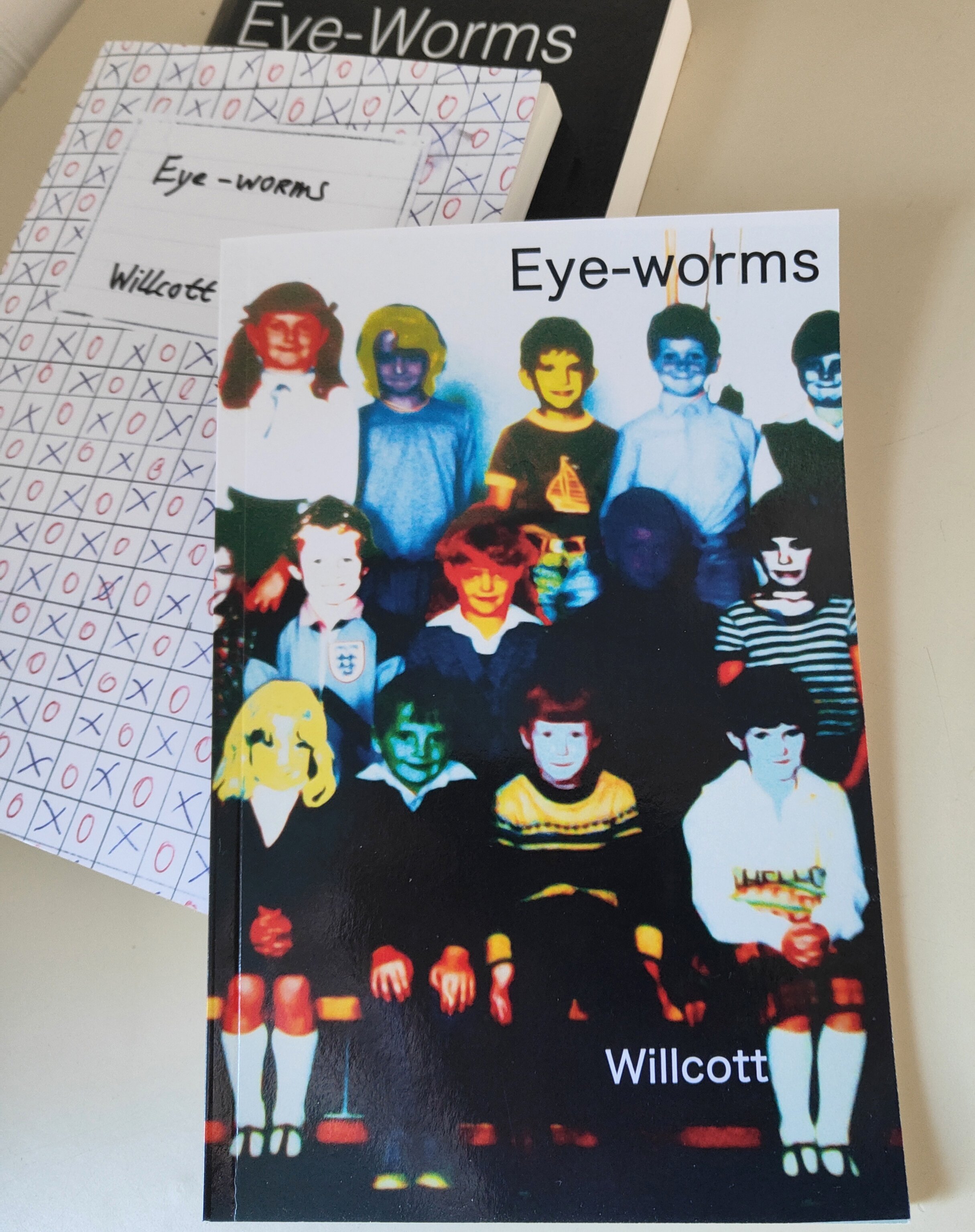
Eye-worms
eye-worm noun /ˈaɪˌwɜːm/plural: eye-worms
A fragment of image, scene, or visual impression that becomes fixed in the imagination, recurring involuntarily or haunting within the mind’s eye. Word of my own creation, formed by analogy with earworm (from German Ohrwurm, literally “ear worm”), denoting a tune that lodges in the mind.
Understanding and Manufacturing an EYE-WORM
Below I outline two complementary approaches to understanding the EYE-WORM. The first describes how I deliberately manufacture an image through repetition, attention and sustained looking, allowing it to become increasingly embedded in perception until it begins to influence how I see the world around me. The second describes how I attempt to uncover an EYE-WORM that appears to have established itself within the mind, tracing its transformations through perception, memory and association in an attempt to discover its possible origins. These are not intended as universal models or clinical explanations, but as working methods developed through my own artistic practice and meditation experience. Together they provide a personal framework for investigating how internal imagery can emerge, persist, transform and become externalised through contemporary art.
Leaving me with the question, how can I create and eye-worm in another person?
Manufacturing an EYE-WORM
1. Choose a simple image: I begin with an extremely simple image—for example, an emoji-like face made from a circle, two dots for eyes and a line for a mouth.
2. Repeat the image: I draw the same image repeatedly. The act of drawing and seeing the image becomes increasingly familiar through repetition.
3. Build a visual residue: Through this repetition, something remains in my visual experience. It is not an after-image or a simple visual trace. It feels deeper, as though the image has become embedded within the way I am seeing.
4. The image begins to appear everywhere: Once the image has been sufficiently established, I begin to see it within the world around me. The image is no longer confined to the drawings. I start to recognise its structure in ordinary objects and environments.
5. The world reorganises itself: A bunch of fruit may appear to contain hundreds of small faces, with individual grapes, apples or oranges becoming components of the image. Outside, trees, leaves, clouds, buildings and pavement can begin to take on the same structure. Bricks may become faces; branches may form mouths; windows may become eyes.
6. The image becomes dominant: The longer I remain within this state, the more extensively the image seems to organise my perception. Eventually, it can feel as though everything is constructed from the same image.
7. The self becomes part of the image: The transformation can extend to my own body. I may begin to experience myself as another instance of the drawn form—as though I too have become part of the visual system I have created.
8. The manufactured EYE-WORM: This is what I call a manufactured EYE-WORM: an internal image deliberately strengthened through repetition until it begins to impose itself upon perception and organise the visual environment around it. The important distinction is that the image did not simply appear spontaneously. I manufactured the conditions for its emergence through repetition, attention and prolonged seeing.
Uncovering an EYE-WORM
1. A Mind in Motion: Thoughts, memories, experiences and images begin to accumulate, forming a constantly changing inner landscape.
2. Becoming Still: I slow the process through meditation, either with my eyes closed or by gazing at a blank wall.
3. The Visual Field: Visual snow and static begin to move and organise themselves. Small forms gather into shapes, patterns and larger structures.
4. The Emerging Image: A colour, shape, pattern or image begins to appear.
5. The First Painting: I respond to what remains of the experience by making the first layer of the painting. I do not try to copy the vision exactly.
6. The Cycle: I meditate again, this time looking at the painting. The painting becomes the new stimulus, producing another visual and synaesthetic response, which creates another layer.
7. Following the Image: The image may trigger memories or associations. Sometimes I begin to recognise where an EYE-WORM comes from; sometimes it remains unresolved.
8. The Encounter: The process becomes a conversation between my internal experience, the painting and eventually the person looking at it. I am trying to communicate the experience without losing what is personal about it.
9. Continuing: The painting may resolve, disappear into white, be painted over or lead to another work. There is no fixed endpoint—the investigation continues.
City Eye-Worms: 100 Paintings from 2020–2022
Limited edition.
City Eye-Worms gathers a selected one hundred paintings from the thousand made, spanning the pandemic and its aftermath. Presented in reverse chronology, these works invite us to experience memory as it unfolds: backward, atmospheric, and sensory.
Innocence Eye-worms
This eye-worm was an apophenic event: a non-consequential puzzle worked through across the hundred paintings in this book. Not finished art, not therapy; simply a record of an intrusion as inspiration and its resolution.
Walking through the city, passing strangers, a hidden image began to surface in my vision. It layer just outside of recognition, like knowing a face without recalling the name. This vague form became the seed of these pages, as each painting explores and clarifies that original invasive image.
Two similar images had fused in my mind. Once their sources were identified, the hybrid collapsed and the eye-worm dissolved. One image was a piece of graffiti I had seen repeatedly and drawn; the final image in City Eye-Worms. The other appeared in a café: a row of smoothies whose logo formed a pareidolic face; two lines and a circle, filled with innocence.